Alexander’s horn
A giant ring of metal, hanging from three wooden poles. A man stands in the middle and blows into one end. Below the hill, the army is only a field of tents. It looks almost too strange to be real.
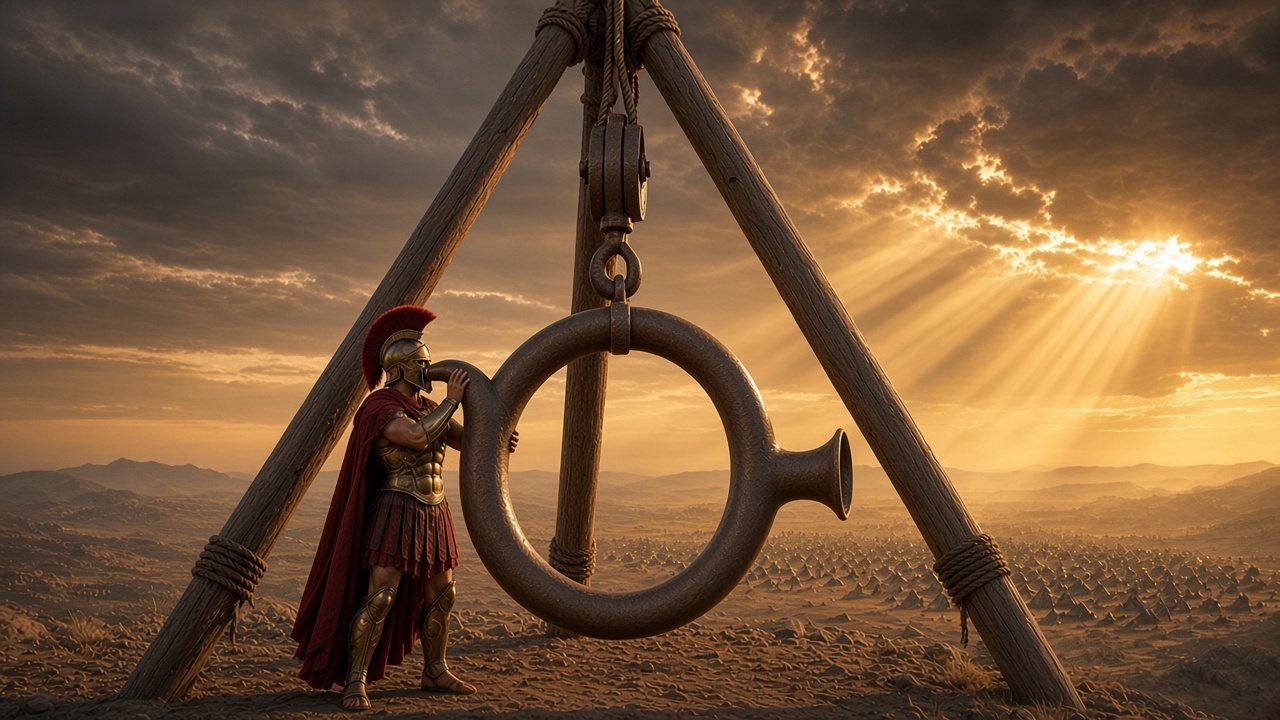
An AI illustration by IfestioGate, created with Grok, after the old engravings of Alexander’s horn.
The story behind the picture is older than the drawing, and less certain than it first appears. That, to me, is what makes it worth sitting with.
A legend, written down late
Nobody from Alexander’s own century describes a horn like this. The earliest written trail is not a Greek historian. It is a later book that pretends to be a letter from Aristotle to Alexander: the Secretum Secretorum, or in Arabic Kitab Sirr al-Asrar, “The Secret of Secrets.” It was composed in Arabic around the ninth or tenth century, then turned into Latin in the twelfth. In the Middle Ages it was widely read. It is not by Aristotle.
And what that book actually describes is not quite the machine in the picture. In the Latin text edited by Robert Steele in 1920, the instrument is a bronze horn made by Temistius — the Arabic manuscripts call him Yayastayus. It is terrible in sound, heard for sixty miles, and so large that sixty men were needed to handle it.
Et oportet te tecum habere illud instrumentum quod fecit Temistius ad opus excercitus ad nocendum, et est instrumentum terribile quod dividitur multis modis, quia forte oportebit te vocare totam provinciam tuam et regnum tuum, et congregare subito proceres tuos bellatores tuos in eadem die vel cicius, vel aliquo modo prout indiget excercitus magnus et numerosus, nam hujus instrumenti sonus auditur per miliaria sexaginta. Hoc est cornu eneum artificio mirabili fabricatum, quo ex .lx. miliariis tempore belli suum excercitum convocabat, et regebatur cornu sexaginta hominibus propter sui magnitudinem et inestimabilem artificium, et verisimile est quod multa metallorum resonancium genera in ejus composicione concurrebant, et hec est forma cornu.
You must also have with you that instrument which Temistius made for the use of the army, for doing harm, and it is a terrible instrument that is divided in many ways, because you may perhaps need to call your whole province and your kingdom, and gather at once your nobles and your warriors on the same day or sooner, or in whatever way a great and numerous army requires, for the sound of this instrument is heard for sixty miles. This is a bronze horn made with marvelous skill, with which in time of war he used to call his army from sixty miles; and the horn was managed by sixty men because of its size and inestimable workmanship, and it is likely that many kinds of resonant metals went into its making, and this is the form of the horn.
Latin text from the Secretum Secretorum, in Roger Bacon’s recension, ed. Robert Steele (Oxford, 1920), p. 151. Steele notes that “ad nocendum” (“for doing harm”) may be an early misreading of “advocandum” (“for calling”). English translation mine, from that Latin. Stanford digital copy.
I looked for the same passage in the original Arabic of Badawi’s 1954 edition of Kitab Sirr al-Asrar, so I could quote it letter by letter. I could not find a digitized page I could check with my own eyes. What we do have, in the same 1920 volume, is A. S. Fulton’s English from Eastern Arabic manuscripts. In copies C and D, the horn is there:
And it is necessary that there should be with thee the instrument which has been invented by Yayastayus for frightening [the enemy]. It is a dread-producing machine which is used for various purposes. Because whenever thou needest to warn all the country and to collect thy forces for battle or for fortification, or any other necessary purpose, and the soldiers are heavy in moving, its sound will be heard for sixty miles. Its shape is this: (diagram).
A. S. Fulton, English version from the Arabic, in Steele, Secretum Secretorum (Oxford, 1920), note to the corresponding passage. The Arabic inventor’s name is given there as Yayastayus.
A different sentence in the same tradition is more general. It does not describe the great horn at all. It simply tells a ruler to keep frightening instruments of sound, even when he does not need them. Yehoshua Frenkel quotes it from Badawi and from Fulton:
And let there be plenty of frightening and terrific sound-producing instruments, even if you do not need them. For verily instruments that produce frightening sounds and alarming voices will inspire thy men with courage and strengthen their spirits. From the opposite end those instruments will terrify thy enemy. Fear will disperse them.
Yehoshua Frenkel, “Mamluk Soundscape,” ASK Working Paper 31 (Bonn, 2018), p. 5, quoting Pseudo-Aristotle in ʿAbd al-Rahman Badawi, al-Usul al-Yunaniyya, p. 150, and Fulton in Steele, p. 248. PDF from the University of Bonn.
So the medieval text gives us a vast, terrifying bronze horn — and, separately, a piece of advice about fear and courage. It does not give us a five-cubit ring hanging from three poles, and it does not say “a hundred stadia.”
Kircher draws the horn
The ring, the three poles, the five cubits, the hundred stadia: that shape comes from Athanasius Kircher, the Jesuit scholar, in Phonurgia Nova, printed at Kempten in 1673. He says that years earlier, in the Vatican Library, he came upon a little book called Secreta Aristotelis ad Alexandrum Magnum.
Aguntur jam complura lustra, quibus in Bibliotheca Vaticana, hieroglyphicum agens Oedipum, casu inciderem in librum, cui titulus erat: Secreta Aristotelis ad Alexandrum Magnum; ubi inter cætera de Cornu prodigioso Alexandri Magni, hæc leguntur: Faciebat hoc cornu adeo vehementem sonum, ut eo exercitum suum ad centum stadia (quorum octo, unum milliare Italicum conficiunt) dispersum, convocasse perhibeatur: habebat autem, ut libellus monstrat, quinque cubitos in diametro; & fulcri suspendebatur annulo, uti Ego reor, cujus tamen figuram non describit. Figuram hic appono, prout in dicto Libello impressam reperi, cum Epigraphe: Cornu Alexandri Magni.
Many five-year spans have already passed since, while I was in the Vatican Library, working as an Oedipus upon hieroglyphs, I happened upon a book entitled Secreta Aristotelis ad Alexandrum Magnum. There, among other things, concerning the prodigious horn of Alexander the Great, these words are read: This horn made so violent a sound that by it he is said to have called together his army, scattered as far as a hundred stadia (of which eight make one Italian mile). It had, as the little book shows, five cubits in diameter; and it was suspended by a ring of a support, as I suppose, though the book does not describe the figure. I place the figure here, as I found it printed in the said booklet, with the caption: Horn of Alexander the Great.
Athanasius Kircher, Phonurgia Nova (Kempten, 1673), p. 132. Transcription from the digitized copy; English translation mine. Internet Archive · Munich, MDZ.
A hundred stadia, in the usual Greek measure, is about eighteen kilometres. Five cubits is about 2.4 metres across. That is the horn we keep imagining. Here is Kircher’s own plate.
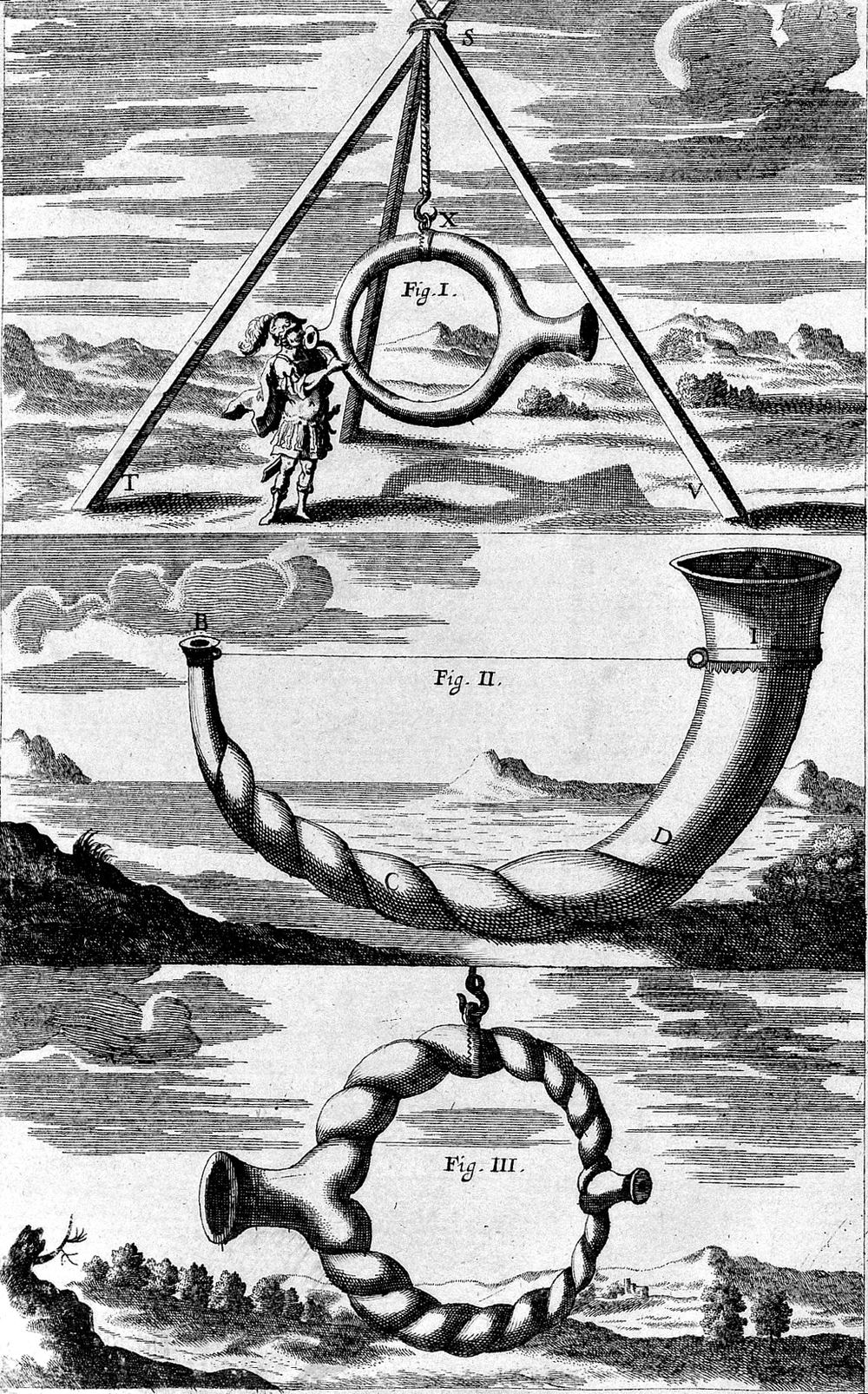
Athanasius Kircher, Phonurgia Nova (Kempten, 1673), plate to p. 132, “De Cornu Alexandri Magni.” The 1673 engraving is in the public domain. Photograph: Wellcome Collection, L0025677, CC BY 4.0, via Wikimedia Commons.

Look at what he admits on the next page. The little book, he says, does not tell us how the horn was held. The tripod is his idea.
Quomodò verò illud manibus tenere valuerit Phonurgus, num pendulum fuerit, Libellus non refert: Nobis hic modus occurrit; & dicimus instrumentum supra fulcrum tripedale plicabile STV. annulo suspensum fuisse, & in omnem partem pro plaga, in quam id dirigere intendebat, versatile fuisse, uti figura hic apposita demonstrat.
How the operator was able to hold it in his hands, or whether it hung, the booklet does not say. This method occurred to us; and we say the instrument was suspended by a ring on a foldable three-legged support STV, and could be turned in every direction toward the quarter in which he meant to aim it, as the figure placed here shows.
Kircher, Phonurgia Nova (1673), p. 133. Transcription from the same copy; English translation mine.
He also imagined a spiral version of the horn, hoping the sound would travel still farther. At the same moment he was in a dispute over who had first described the speaking trumpet. In 1671–72 the English inventor Samuel Morland published his Tuba Stentoro-Phonica — a trumpet named after Stentor, the Greek herald whose voice, in Homer, was like the voice of fifty men.
ἔνθα στᾶσ᾽ ἤϋσε θεὰ λευκώλενος Ἥρη / Στέντορι εἰσαμένη μεγαλήτορι χαλκεοφώνῳ, / ὃς τόσον αὐδήσασχ᾽ ὅσον ἄλλοι πεντήκοντα
there the goddess, white-armed Hera, stood and shouted in the likeness of great-hearted Stentor of the brazen voice, whose voice is as the voice of fifty other men
Homer, Iliad 5.784–786. Greek: Oxford text, ed. Monro and Allen (1920), via Perseus. English: A. T. Murray, Loeb Classical Library (1924), via Perseus.
Kircher had already written about sound in his Musurgia Universalis of 1650. He also built speaking tubes of his own. Later accounts of his work say that from a hill at Mentorella his voice was heard for some kilometres. That part, at least, belongs to the seventeenth century. The eighteen kilometres of Alexander’s horn do not.
What the sources do not support
In 1920, when Steele went back to the manuscripts, he was plain about Kircher’s picture and Kircher’s numbers:
From this woodcut the horn was copied incorrectly by Kircher in his Ars magna lucis et umbrae, ii. 1. 7 (Rome 1646, p. 140), and again in his Phonurgia nova (1674, p. 132), in which work an engraved plate is given with suggestions as to its use.
Kircher’s note as to the size of the horn (five cubits in diameter) and the distance at which it could be heard (100 stadia) does not seem to rest on any manuscript authority.
Robert Steele, introduction to Secretum Secretorum (Oxford, 1920), p. lviii. Steele’s date “1674” refers to the same work printed at Kempten in 1673.
So the image we love is a seventeenth-century reconstruction, drawn from a medieval legend — and even the legend does not give Kircher’s measurements. As early as 1683, the German scholar Daniel Georg Morhof is reported to have rejected Kircher’s reading of the same text. I have not quoted Morhof here, because I could not check his words on the page.
Alexander’s ancient biographers, including Arrian, do not describe a machine like this. Some popular articles mention Arrian, but they do not point to a passage in his text.
What ancient armies did have were real signal instruments: the bronze salpinx, a long straight trumpet, and the bykane, a horn. Those we can still study. A horn that calls men from eighteen kilometres is, by the physics of unaided sound, almost certainly a legend.
And yet the wish inside the story is simple, and it never went away: to be heard far away.
From the horn to a voice that answers
In the eighteenth century the legend was still being told as if it were a fact of engineering. The Encyclopédie, in the article “Porte-voix,” repeats it, then turns to Morland’s improved trumpet.
On dit qu’Alexandre avoit un semblable porte-voix, à l’aide duquel il rassembloit son armée, quelque grande & quelque dispersée qu’elle pût être, & lui donnoit ses ordres, comme s’il se trouvoit en présence de chaque soldat, & qu’il parlât à chacun d’eux en particulier. Kircher a donné la figure de cette sorte de trompette, & en a fait faire une sur son modele. Mais depuis que le chevalier Morland s’est appliqué à perfectionner ces trompettes, elles ont commencé à être bien connues.
It is said that Alexander had a similar megaphone, with whose aid he assembled his army, no matter how large or how dispersed it might be and gave it his orders as if he were in the presence of each soldier and spoke to each of them individually. Kircher has provided an illustration of this sort of trumpet and has had one made modelled on it. But since Sir Morland has applied himself to improving these trumpets, they have begun to be well known.
“Porte-voix,” in Diderot and d’Alembert, Encyclopédie, vol. 13 (1765), pp. 143–144. French: Wikisource. English: The Encyclopedia of Diderot & d’Alembert Collaborative Translation Project.
After that, the line is familiar. The speaking trumpet becomes the megaphone. In 1876 Alexander Graham Bell’s telephone carries a voice along a wire. Around 1895 to 1901, Guglielmo Marconi takes a signal still farther, without the wire. Today a voice assistant listens, and talks back.
Horn, megaphone, telephone, radio, AI. The tools change. The wish is the same.
A short reconstruction: the horn stays in one piece, without fire or dust. After the call, the camera lifts and looks down the hill to the army. AI video by IfestioGate, created with Grok.
Twenty-three hundred years after Alexander, we still want to be heard at a distance. The difference is that now the machine answers.
One day a horn like this could live again as a 3D model in the metaverse — not as a proof of the past, only as a way to hold a legend in your hands and walk around it.
Sources
- Pseudo-Aristotle, Secretum Secretorum / Kitab Sirr al-Asrar. Latin and Fulton’s English in Robert Steele, ed., Opera hactenus inedita Rogeri Baconi, fasc. V (Oxford: Clarendon Press, 1920), esp. pp. lviii and 151. Stanford Libraries PDF. Overview: Wikipedia.
- Athanasius Kircher, Phonurgia Nova (Kempten: Rudolph Dreherr, 1673), pp. 132–133 and the engraved plate. Internet Archive · Bayerische Staatsbibliothek / MDZ. See also Phonurgia Nova and Athanasius Kircher.
- Kircher plate: Wellcome Collection, L0025677, CC BY 4.0. wellcomecollection.org · Wikimedia Commons.
- Yehoshua Frenkel, “Mamluk Soundscape. A Chapter in Sensory History,” ASK Working Paper 31 (Bonn, July 2018). University of Bonn PDF.
- André Lange, “Les traités d’acoustique d’Athanasius Kircher,” histv.net — useful on Kircher, Morland, Mentorella, and the later discussion of Morhof, though I have quoted the primary texts themselves wherever I could.
- “Porte-voix,” in Diderot and d’Alembert, Encyclopédie, vol. 13 (Paris, 1765), pp. 143–144. French, Wikisource · English translation.
- Homer, Iliad 5.784–786. Greek (Perseus) · Murray, English (Perseus).
- Samuel Morland and the speaking trumpet: Samuel Morland · Megaphone.
- Ancient signal instruments: salpinx; Kotsanas Museum, the salpinx and the keras or bykane.
- Later steps in the same wish to be heard far away: the telephone, 1876 · Alexander Graham Bell · the invention of radio · Guglielmo Marconi.
Notes by email
New stories when I publish. No spam.